Sustainable Digital Label
Sustainable Digital Label
Sustainable Digital Label
NEXQT is committed to integrating Sustainable Digital practices across all its activities. This approach aims to reduce the environmental and social impacts associated with digital technologies, while continuously improving the efficiency and relevance of its services.
NEXQT is committed to integrating Sustainable Digital practices across all its activities. This approach aims to reduce the environmental and social impacts associated with digital technologies, while continuously improving the efficiency and relevance of its services.
Our approach
Our approach
NEXQT provides a SaaS platform accessible to all local authority officers responsible for steering the decarbonisation of their territory.
Our mission is to generate a positive impact by accelerating the ecological transition through a digital service that is simple, robust, and designed specifically for territorial needs.
However, it is essential to assess NEXQT’s net contribution to the transition. This means also accounting for potential negative environmental impacts of its digital service (e.g. lifecycle and GHG emissions of infrastructure, possible exclusion of certain agents or citizens) and weighing them against the benefits it enables (e.g. reduction in GHG emissions, empowerment of public agents and citizens in their territorial transition).
As the NEXQT platform inherently processes large volumes of territorial data, algorithms, and computing power, its externalities must be identified, measured, and controlled.
NEXQT aims to grow—both in terms of the number of territories supported (more data, more computation) and the number of team members, who will need to adopt and share best practices. It is therefore NEXQT’s responsibility to maximize the net benefit delivered to the planet and to the people of our territories, while also raising awareness of these issues throughout its ecosystem.
NEXQT provides a SaaS platform accessible to all local authority officers responsible for steering the decarbonisation of their territory.
Our mission is to generate a positive impact by accelerating the ecological transition through a digital service that is simple, robust, and designed specifically for territorial needs.
However, it is essential to assess NEXQT’s net contribution to the transition. This means also accounting for potential negative environmental impacts of its digital service (e.g. lifecycle and GHG emissions of infrastructure, possible exclusion of certain agents or citizens) and weighing them against the benefits it enables (e.g. reduction in GHG emissions, empowerment of public agents and citizens in their territorial transition).
As the NEXQT platform inherently processes large volumes of territorial data, algorithms, and computing power, its externalities must be identified, measured, and controlled.
NEXQT aims to grow—both in terms of the number of territories supported (more data, more computation) and the number of team members, who will need to adopt and share best practices.
It is therefore NEXQT’s responsibility to maximize the net benefit delivered to the planet and to the people of our territories, while also raising awareness of these issues throughout its ecosystem.
NEXQT provides a SaaS platform accessible to all local authority officers responsible for steering the decarbonisation of their territory.
Our mission is to generate a positive impact by accelerating the ecological transition through a digital service that is simple, robust, and designed specifically for territorial needs.
However, it is essential to assess NEXQT’s net contribution to the transition. This means also accounting for potential negative environmental impacts of its digital service (e.g. lifecycle and GHG emissions of infrastructure, possible exclusion of certain agents or citizens) and weighing them against the benefits it enables (e.g. reduction in GHG emissions, empowerment of public agents and citizens in their territorial transition).
As the NEXQT platform inherently processes large volumes of territorial data, algorithms, and computing power, its externalities must be identified, measured, and controlled.
NEXQT aims to grow—both in terms of the number of territories supported (more data, more computation) and the number of team members, who will need to adopt and share best practices.
It is therefore NEXQT’s responsibility to maximize the net benefit delivered to the planet and to the people of our territories, while also raising awareness of these issues throughout its ecosystem.
NEXQT is currently engaged in the Sustainable Digital Label – Level 1 certification, led by INR and the Lucie agency, with a target completion by mid-2026.
In parallel, our teams—and particularly our decision-makers—are following the REFRESH training programme organised by Cap Digital and the Île-de-France Region.
NEXQT is currently engaged in the Sustainable Digital Label – Level 1 certification, led by INR and the Lucie agency, with a target completion by mid-2026.
In parallel, our teams—and particularly our decision-makers—are following the REFRESH training programme organised by Cap Digital and the Île-de-France Region.
NEXQT is currently engaged in the Sustainable Digital Label – Level 1 certification, led by INR and the Lucie agency, with a target completion by mid-2026.
In parallel, our teams—and particularly our decision-makers—are following the REFRESH training programme organised by Cap Digital and the Île-de-France Region.
What does Sustainable Digital mean for NEXQT’s services?
What does Sustainable Digital mean for NEXQT’s services?
Applying Sustainable Digital principles to the decarbonisation of urban activities means delivering an ethical and responsible information platform, combining technical performance with strong social and environmental requirements.
Applying Sustainable Digital principles to the decarbonisation of urban activities means delivering an ethical and responsible information platform, combining technical performance with strong social and environmental requirements.
Responsible AI serving the decarbonisation of cities
Strategic pillars
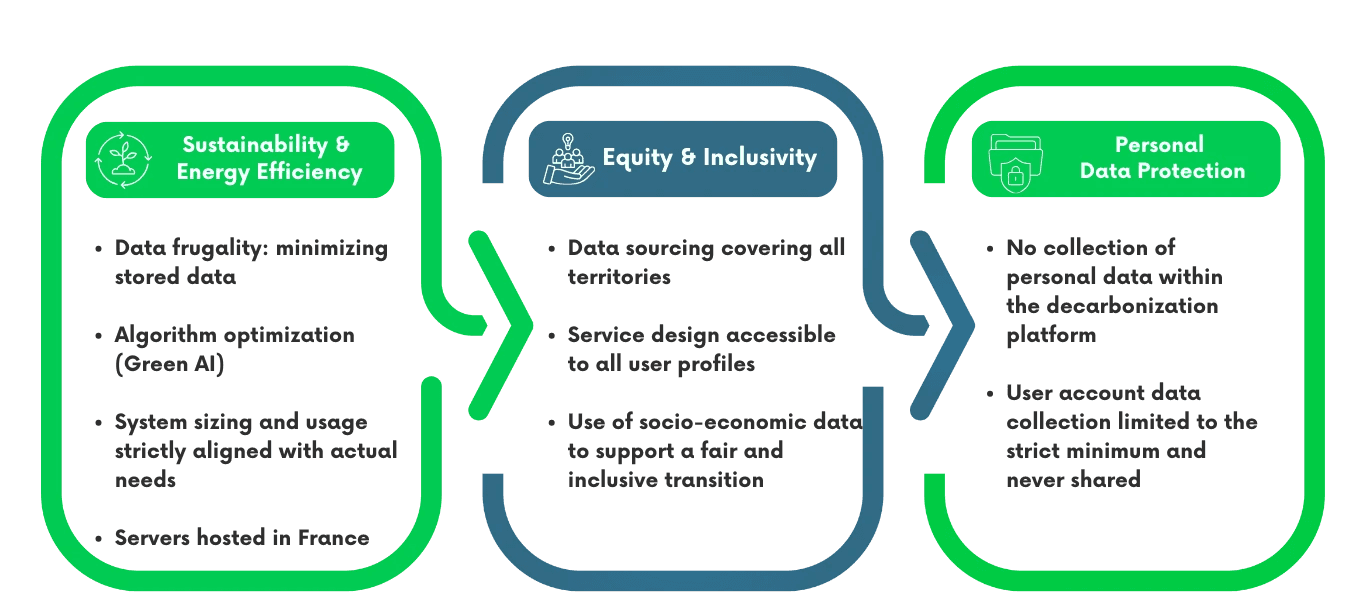
Pillar 1: Optimisation and control of cloud usage
By partnering with AWS, our main provider of storage and computing servers
Sparing storage of territorial data: adjusted as needed while respecting statistical confidentiality
Efficiency of algorithms and queries: the most frugal methods and infrastructure possible
Measurement of the GHG impact of our activity on the cloud (storage and dematerialized computing) in collaboration with AWS
In collaboration with our main cloud storage and computing provider:
Data minimisation: storing only the local data strictly required, while respecting statistical confidentiality.
Algorithm and query efficiency: prioritising the most resource-efficient methods and infrastructures.
Measurement of GHG impacts linked to cloud usage (storage and computing), in partnership with our cloud provider.
To maximize its positive impact, our online activity must be exemplary in its simplicity but also useful and accessible to our collaborators both internally and externally
Accessibility of existing features: internally relying on our own no-code territory configuration / feedback from territorial user agents and support from graphic designers
Eco-design of new features (Useful, Usable, and Used)
Sobriety in the collection of personal data, limited to what is strictly necessary (last name, first name, user emails)
Improvements underway for the sobriety and accessibility of the showcase site (EcoIndex, Wave), no cookies collected
To maximise its positive impact, our online activity must be exemplary in terms of sobriety, usefulness, and accessibility—for both internal and external users.
Accessibility of existing features, supported by our own no-code territorial configuration, user feedback, and UX/UI designers.
Eco-design of new features (Useful, Usable, and Used).
Data minimisation: collection of personal data strictly limited to what is necessary (first name, last name, user email).
Ongoing improvements to the sobriety and accessibility of our public website (EcoIndex, Wave), with no tracking cookies collected.
Pillar 3: Embedding Sustainable Digital practices early to anticipate company growth
Today’s team members will lead—or pass the torch to—tomorrow’s teams. This relies in particular on:
The internal wiki as a lever to place Sustainable Digital practices at the heart of the company’s information system.
Responsible maintenance and renewal of IT equipment.
Good software development practices.
Clear commitments towards users and suppliers.
Today’s team members will lead—or pass the torch to—tomorrow’s teams. This relies in particular on:
The internal wiki as a lever to place Sustainable Digital practices at the heart of the company’s information system.
Responsible maintenance and renewal of IT equipment.
Good software development practices.
Clear commitments towards users and suppliers.
Key indicators on the NEXQT platform
Discover the GHG counter supervised by NEXQT on our website: Nexqt | Decarbonizing the city.
To date, NEXQT supports urban and rural territories representing:
0
teqCO2
Since 2021, a decrease in GHG emissions has been observed.
-0.0%
The management of Climate Plans made possible by NEXQT:
Our contribution to the decarbonization of cities
The climate plans piloting made possible by NEXQT
Impact of AWS cloud servers:
Impact of cloud servers
NEXQT has entered into a logic of methodological exchanges on carbon indicators with AWS, its main cloud service provider (calculations and storage).
Thus, since July 2025, NEXQT can now, via AWS's CCFT service, account for all scope 1 and scope 2 GHG emissions related to its use of the cloud and objectively assess the environmental impact of its technical choices.
Current figures: Our monthly carbon footprint across all uses on AWS in 2025 ranges between 10 and 22 kgCO2eq/month (equivalent to a maximum of about twenty days of continuous operation of a 1kW electric heater in France)
NEXQT has entered a methodological exchange with its main cloud service provider regarding carbon indicators related to computing and storage.
Since July 2025, NEXQT has been able—using a carbon calculator provided by this partner—to account for Scope 1 and Scope 2 GHG emissions linked to its cloud usage, and to objectively assess the environmental impact of its technical choices.
Compliance rate with the RGAA (General Reference for Improving Accessibility):
Accessibility
The NEXQT platform as well as the public website are currently compliant at 59% with RGAA 4.1 (internal audit from August 2025)
For more details, see our accessibility statement.
NEXQT has set itself a 4-year plan to improve this compliance rate (gradually up to 90%) and several other underlying indicators (see the multiyear digital accessibility plan).
The underlying metrics include:
The contrast errors detected by the Wave tool.
The average score on climate impact and accessibility obtained through our user surveys (after 6 months of use)
The removal of blocking difficulties for our internal collaborators.
NEXQT has defined a 4-year roadmap to progressively improve its accessibility compliance rate (up to 90%), along with several related indicators.
Exemplary sobriety of our public website:
Our public site, although relatively heavy in requests and data volume, has improved its EcoIndex score from F to ≤ C
Applying Sustainable Digital principles to the decarbonisation of urban activities means delivering an ethical and responsible information platform, combining technical performance with strong social and environmental requirements.
Strategic pillars
Axis 1: Optimization and control of our cloud usage
En embarquant AWS, notre principal fournisseur de serveurs stockage et calcul
Stockage parcimonieux de la donnée territoriale: ajustée au besoin et respect du secret statistique
Efficacité des algorithmes et des requêtes: méthodes et infras les plus frugales possibles
Mesure de l’impact GES de notre activité sur le cloud (stockage et calcul dématérialisé) en collaboration avec AWS
In collaboration with our main cloud storage and computing provider:
Data minimisation: storing only the local data strictly required, while respecting statistical confidentiality.
Algorithm and query efficiency: prioritising the most resource-efficient methods and infrastructures.
Measurement of GHG impacts linked to cloud usage (storage and computing), in partnership with our cloud provider.
Pillar 2: Digital sobriety and accessibility
To maximise its positive impact, our online activity must be exemplary in sobriety, but also useful and accessible to internal and external users.
Accessibility of existing features: internally through our no-code territorial configuration; based on user feedback from territorial agents; and with support from UX/UI designers
Eco-design of new features: ensuring they are Useful, Usable and Used
Data minimisation: collecting only strictly necessary personal data (first name, last name, user email)
Ongoing improvements to the sobriety and accessibility of our public website (EcoIndex, Wave), with no cookies collected
To maximize its positive impact, our online activity must be exemplarily simple but also useful and accessible to our collaborators both internally and externally.
Accessibility of existing features: internally relying on our own no-code territory configuration / user feedback and support from UX/UI designers.
Eco-design of new features (Useful, Usable, and Used).
Simplicity in the collection of personal data, limited to what is strictly necessary (name, first name, users' emails).
Ongoing improvements in the simplicity and accessibility of the showcase site (EcoIndex, Wave), no cookies collected.
Pillar 3: Embedding Sustainable Digital practices early to anticipate company growth
Today’s team members will lead—or pass the torch to—tomorrow’s teams. This relies in particular on:
The internal wiki as a lever to place Sustainable Digital practices at the heart of the company’s information system.
Responsible maintenance and renewal of IT equipment.
Good software development practices.
Clear commitments towards users and suppliers.
Today’s team members will lead—or pass the torch to—tomorrow’s teams. This relies in particular on:
The internal wiki as a lever to place Sustainable Digital practices at the heart of the company’s information system.
Responsible maintenance and renewal of IT equipment.
Good software development practices.
Clear commitments towards users and suppliers.
The climate plans piloting made possible by NEXQT
To date, NEXQT supports urban and rural territories representing:
0
teqCO2
Since 2021, a decrease in GHG emissions has been observed.
-0.0%
Key indicators on the NEXQT platform
The climate plans piloting made possible by NEXQT
Our contribution to the decarbonization of cities
Find the GHG meter supervised by NEXQT on our site Nexqt | Decarbonizing the city.
The climate plans piloting made possible by NEXQT
Impact of AWS cloud servers
Impact of cloud servers
NEXQT has entered a methodological exchange with its main cloud service provider regarding carbon indicators related to computing and storage.
Since July 2025, NEXQT has been able—using a carbon calculator provided by this partner—to account for Scope 1 and Scope 2 GHG emissions linked to its cloud usage, and to objectively assess the environmental impact of its technical choices.
NEXQT has entered a methodological exchange with its main cloud service provider regarding carbon indicators related to computing and storage.
Since July 2025, NEXQT has been able—using a carbon calculator provided by this partner—to account for Scope 1 and Scope 2 GHG emissions linked to its cloud usage, and to objectively assess the environmental impact of its technical choices.
Compliance rate with the RGAA (General Reference for Improving Accessibility)
Accessibility
The NEXQT platform as well as the public website are currently compliant at 59% with RGAA 4.1 (internal audit from August 2025).
For more details, see our accessibility statement.
NEXQT has set a 4-year plan to improve this compliance rate (gradually up to 90%) and several other underlying indicators (see the multi-year digital accessibility roadmap).
The underlying metrics include:
The contrast errors identified by the Wave tool.
The average score on climate impact and accessibility obtained through our user questionnaires (after 6 months of use).
The removal of blocking difficulties for our internal collaborators.
NEXQT has defined a 4-year roadmap to progressively improve its accessibility compliance rate (up to 90%), along with several related indicators.
Or contact us directly by email at:
hello@nexqt.com
Or contact us directly by email at:
hello@nexqt.com
This Sustainable Digital Label initiative is supported by the Île-de-France Region and Cap Digital, as part of the REFRESH programme.
This Sustainable Digital Label initiative is supported by the Île-de-France Region and Cap Digital, as part of the REFRESH programme.
This approach to labeling Responsible Digital label benefits from the support of the Île-de-France Region and Cap Digital, as part of the REFRESH program.
This Sustainable Digital Label initiative is supported by the Île-de-France Region and Cap Digital, as part of the REFRESH programme.
Strategic pillars
Pillar 1: Optimisation and control of cloud usage
In collaboration with our main cloud storage and computing provider:
Data minimisation: storing only the local data strictly required, while respecting statistical confidentiality.
Algorithm and query efficiency: prioritising the most resource-efficient methods and infrastructures.
Measurement of GHG impacts linked to cloud usage (storage and computing), in partnership with our cloud provider.
By partnering with our main server supplier for storage and computing.
Sparing storage of local data: adjusted to need and respect for statistical confidentiality.
Efficiency of algorithms and queries: the most frugal methods and infrastructures possible.
Measurement of the GHG impact of our activity on the cloud (storage and dematerialized computing) in collaboration with our server supplier.
Pillar 2: Digital sobriety and accessibility
To maximise its positive impact, our online activity must be exemplary in terms of sobriety, usefulness, and accessibility—for both internal and external users.
Accessibility of existing features, supported by our own no-code territorial configuration, user feedback, and UX/UI designers.
Eco-design of new features (Useful, Usable, and Used).
Data minimisation: collection of personal data strictly limited to what is necessary (first name, last name, user email).
Ongoing improvements to the sobriety and accessibility of our public website (EcoIndex, Wave), with no tracking cookies collected.
Pillar 3: Embedding Sustainable Digital practices to anticipate company growth
Pillar 3: Embedding Sustainable Digital practices early to anticipate company growth
Today’s team members will lead—or pass the torch to—tomorrow’s teams. This relies in particular on:
The internal wiki as a lever to place Sustainable Digital practices at the heart of the company’s information system.
Responsible maintenance and renewal of IT equipment.
Good software development practices.
Clear commitments towards users and suppliers.
Key indicators on the NEXQT platform
Our contribution to the decarbonization of cities
Discover the GHG counter supervised by NEXQT on our website: Nexqt | Decarbonizing the city.
Discover the GHG counter supervised by NEXQT on our website: Nexqt | Decarbonizing the city.
To date, NEXQT supports urban and rural territories representing:
0
teqCO2
Since 2021, a decrease in GHG emissions has been observed.
-0.0%
To date, NEXQT supports urban and rural territories representing:
0
teqCO2
Since 2021, a decrease in GHG emissions has been observed.
-0.0%
Cloud infrastructure impact
NEXQT has entered a methodological exchange with its main cloud service provider regarding carbon indicators related to computing and storage.
Since July 2025, NEXQT has been able—using a carbon calculator provided by this partner—to account for Scope 1 and Scope 2 GHG emissions linked to its cloud usage, and to objectively assess the environmental impact of its technical choices.
Accessibility
NEXQT has defined a 4-year roadmap to progressively improve its accessibility compliance rate (up to 90%), along with several related indicators.
This Sustainable Digital Label initiative is supported by the Île-de-France Region and Cap Digital, as part of the REFRESH programme.
This Sustainable Digital Label initiative is supported by the Île-de-France Region and Cap Digital, as part of the REFRESH programme.
Or contact us directly by email at:
hello@nexqt.com